
DIN Standard Chain

What is a DIN standard chain? A DIN standard chain refers to roller chains whose dimensions and core technical specifications are defined within a standardized system. In industrial applications, this term is predominantly used for European-standard transmission chains.
Key features:
-
Chain pitch conforms to designated dimensional groups.
-
Pin, bushing, roller, and link plate dimensions are strictly defined.
-
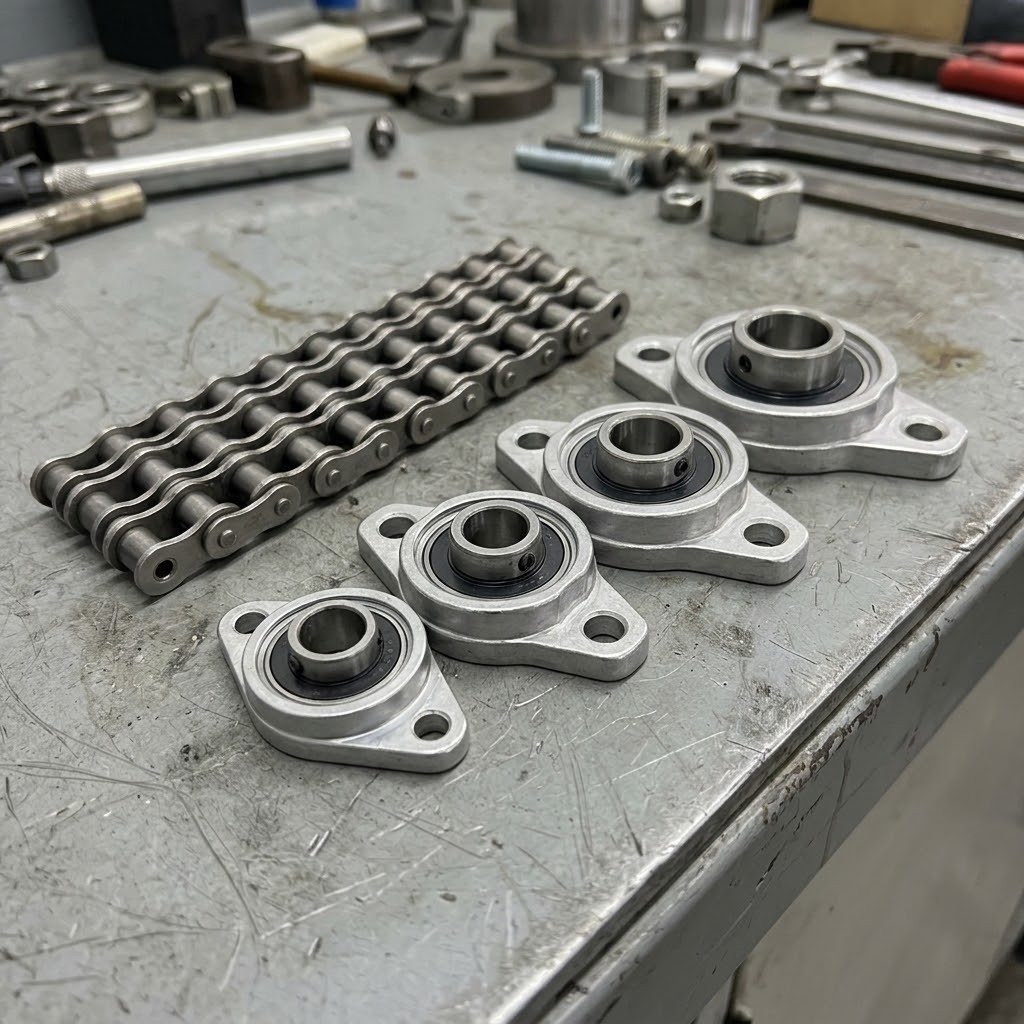
Available in single (simplex), double (duplex), or triple (triplex) strands.
-
Operates with dimensionally compatible sprockets.
-
Used in power transmission and select conveyor applications.
-
Product codes indicate the dimensional series and number of strands.
When selecting a DIN standard chain, one should not rely solely on the product code. Operating load, rotational speed (RPM), environmental conditions, sprocket dimensions, and the lubrication method must also be taken into account. Dimensional standardization facilitates the interchangeable use of identical-class chains from different manufacturers in compatible systems. Under ISO 606, dimensions, tolerances, length measurement, and mechanical properties are specified for short-pitch roller chains.
What Does a DIN Standard Chain Represent?
DIN is a standardization system that defines industrial products within specific dimensional and technical rules. In the chain sector, the term DIN is widely used to describe the dimensional structure of European-standard roller chains in particular.
The term "DIN chain" is not a brand name, but a technical classification defining specific dimensions and product construction.
In industry, the product family known as DIN 8187 is associated with European-standard simplex (single), duplex (double), and triplex (triple) strand roller chains. DIN 8188, on the other hand, represents a separate product family covering American-standard roller chain configurations. Although these two series serve similar operational purposes, their dimensional structures differ.
The primary components of DIN chains are:
- Inner and outer link plates
- Pins
- Bushings
- Rollers
- Connecting links (master links)
- Intermediate link plates in multi-strand configurations
The dimensional precision and compatibility of these components ensure that the chain seats smoothly on the sprocket and transmits motion in a controlled manner.
How to Read DIN Chain Codes
DIN standard chains are typically designated by codes such as 06B, 08B, 10B, 12B, and 16B. The letter "B" at the end of the code indicates the European chain series, while the numeral following the hyphen specifies the number of strands.
Sample designations:
- 08B-1: Single-strand (simplex) chain
- 08B-2: Double-strand (duplex) chain
- 08B-3: Triple-strand (triplex) chain
- 12B-1: Single-strand chain with a larger pitch
- 16B-2: Double-strand chain suited for higher load transmission
As the strand count in the product code increases, the overall width of the chain and its load transmission capacity increase accordingly.
| Chain Code | Strand Structure | General Application Scope |
| 06B-1 | Single-strand (Simplex) | Compact, low-load mechanisms |
| 08B-1 | Single-strand (Simplex) | General machinery and drive systems |
| 10B-1 | Single-strand (Simplex) | Medium-duty industrial machinery |
| 12B-1 | Single-strand (Simplex) | Systems requiring higher load capacity |
| 08B-2 | Double-strand (Duplex) | Increased power transmission |
| 12B-2 | Double-strand (Duplex) | Heavy-duty operating conditions |
| 16B-3 | Triple-strand (Triplex) | High-capacity specialized applications |
In European chain catalogs, nominal pitch dimensions are 9.525 mm for 06B-1, 12.70 mm for 08B-1, and 19.05 mm for 12B-1. Within the same code series, multi-strand chains maintain identical pitch dimensions while overall assembly width increases.
What Is the Difference Between DIN and ANSI Chains?
Although DIN and ANSI chains can perform similar transmission functions, their dimensional geometry is distinct. The designation "DIN chain" generally identifies the European B-series, whereas "ANSI chain" refers to the American A-series.
Key structural differences include:
- Chain designation and coding system
- Pin diameter
- Roller diameter
- Inner width between link plates
- Link plate height
- Total chain width
- Sprocket tooth profile
DIN and ANSI chains sharing the same pitch value must not be directly interchanged, as their respective component dimensions differ.
For example, an 08B chain in the DIN category and a No. 40 chain in the ANSI category share the same nominal pitch of 1/2 inch (12.70 mm). However, discrepancies in roller diameter, plate thickness, and inner width will prevent correct sprocket engagement.
When replacing a chain, verify the standard to which the existing transmission was manufactured. A chain that does not mesh correctly with the sprocket causes noise, vibration, uneven wear, and chain hopping. DIN Media catalogs classify European and American roller chains under separate standard families.
Where Are DIN Standard Chains Used?
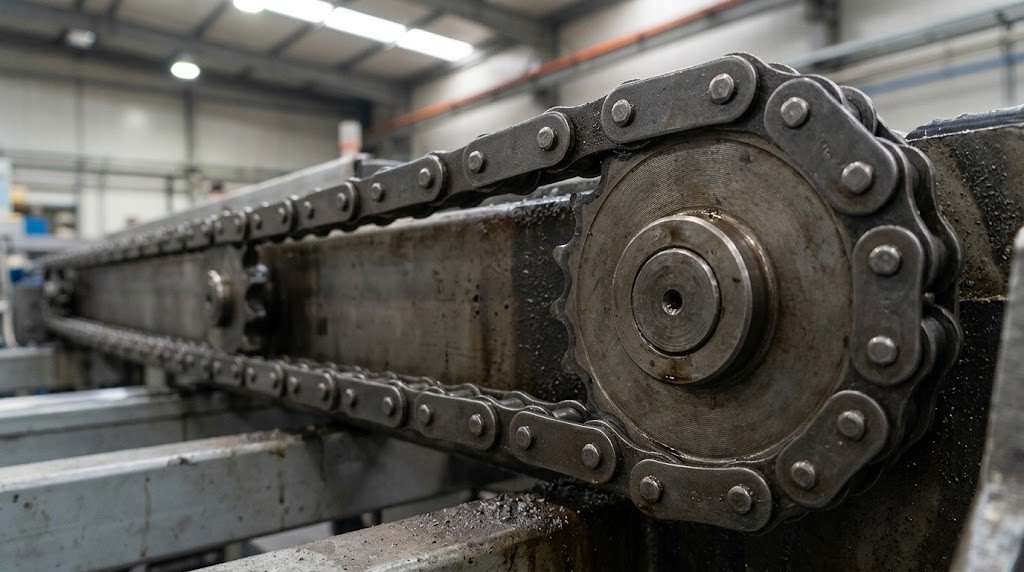
DIN standard chains are employed across numerous industrial systems where rotary motion must be transferred from one shaft to another. Standardized sizing simplifies replacement planning and sprocket pairing.
Common applications include:
- Machinery manufacturing
- Geared drive systems and gearmotors
- Conveyor lines
- Packaging machinery
- Agricultural machinery
- Textile machinery
- Food processing equipment
- Woodworking machinery
- Automation systems
- Plant maintenance and retrofitting
The operating load and environmental conditions dictate the suitability of a DIN standard chain far more than the product code alone.
Standard carbon steel chains are used in general industrial settings. For systems exposed to moisture, washdowns, or chemicals, stainless steel or anti-corrosion coated options are necessary. For conveyor lines with flight attachments, chains equipped with straight, bent, or custom attachment lugs are specified.
Extended-pin and attachment-lug models can also be built on base DIN chain dimensions; however, attachment hole spacings and heights must be verified against existing conveyor track clearances.
How to Select a DIN Standard Chain
Proper selection requires evaluating the machine's technical specifications alongside the physical measurements of the existing chain. Sizing should never be decided based solely on overall outer width or total chain length.
- Define the specific operational function of the chain in the machine.
- Read and record the existing product code stamped on the outer plates.
- Measure the pitch between the centers of two consecutive pins.
- Measure the roller outer diameter.
- Measure the inside width between the inner link plates.
- Confirm single-strand (simplex), double-strand (duplex), or triple-strand (triplex) construction.
- Inspect the sprocket dimensions, tooth count, and wear profile.
- Compile operating load, power rating, and shaft RPM data.
- Assess ambient temperature, humidity, washdown frequency, and debris exposure.
- Determine the required total length or link count.
- Select the appropriate connecting link style (spring clip or cottered pin).
- Establish the lubrication method and maintenance interval.
- Compliance with DIN standard dimensions does not alone confirm that the chain's ultimate load capacity is sufficient for dynamic operation.
In addition to dimensional limits and tolerances, ISO 606 specifies minimum tensile strength and dynamic fatigue properties. Final selection must be cross-checked against manufacturer load ratings and actual duty-cycle factors.
Maintenance and Chain-Sprocket Compatibility
To maintain smooth operation in DIN chain drives, tensioning, alignment, and lubrication checks must be performed together. Chain elongation over time is primarily driven by mechanical wear between the pin and bushing contact surfaces.
Inspect for the following wear indicators during maintenance:
- Uneven chain elongation across sections
- Stiff, binding, or seized links
- Rotating pins within the outer plates
- Roller flat spots, cracking, or severe scouring
- Fatigue cracks on side plates
- Slack or deformed connecting links
- Hook-shaped (undercut) wear on sprocket teeth
- Lateral misalignment along the chain line
- Insufficient, contaminated, or excessive lubrication
- Elevated operating noise and vibration
Installing a new chain on a worn sprocket will rapidly accelerate chain wear and significantly reduce its operational life.
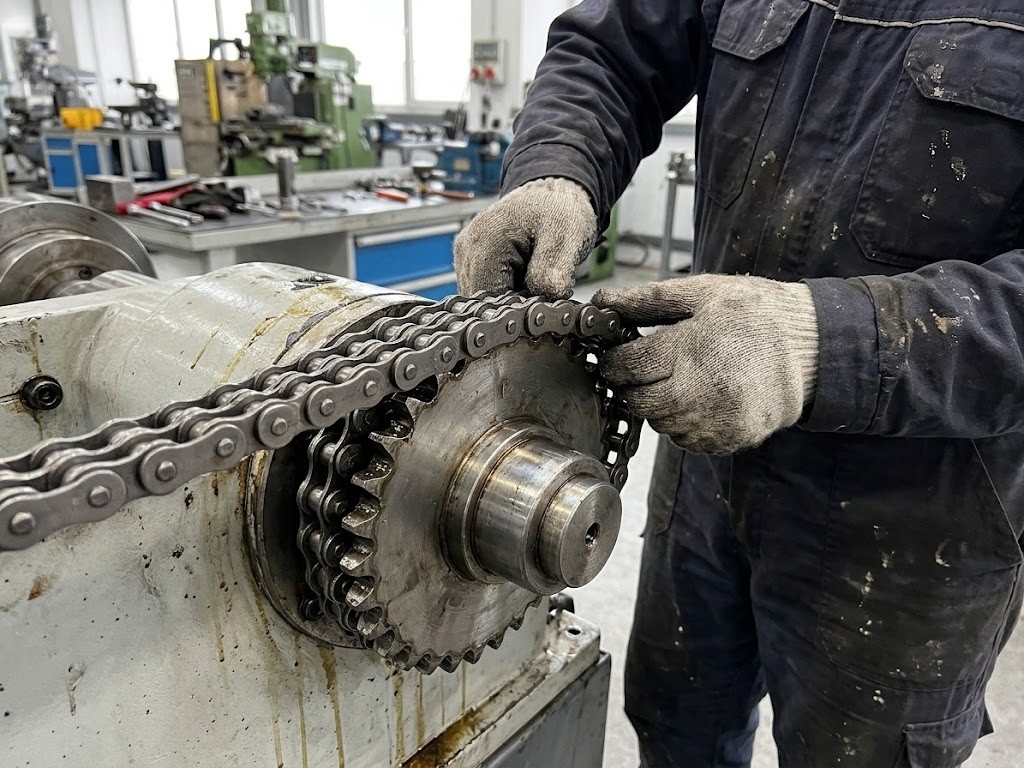
When installing a replacement chain, verify the sprocket tooth profile, parallel shaft alignment, and bearing play. Avoid excessive pre-tensioning; an appropriate amount of slack must be maintained to match the system layout. Proper drive performance requires treating the chain and its sprockets as an integrated pair.
Zincir Gross DIN Chain Solutions
Zincir Gross supplies DIN standard chain solutions to machinery manufacturers, industrial plants, maintenance divisions, and corporate procurement departments across Turkey.
The product range encompasses:
- Single-strand DIN transmission chains
- Duplex and triplex roller chains
- Stainless steel corrosion-resistant roller chains
- Attachment-lug and extended-pin conveyor chains
- Connecting and offset links
- Compatible sprockets and plate wheels
- UHMW-PE chain guide profiles
- Component identification and verification from physical samples
- Custom attachments manufactured to technical drawings
In evaluations conducted with Zincir Gross, the chain code, critical physical dimensions, operating load, sprocket parameters, and operating environment are reviewed concurrently, preventing costly mismatches caused by confusing DIN and ANSI dimensional standards.
DIN Chain Selection Checklist
Verify the following parameters in writing before ordering:
- Chain designation code and standard series (e.g., ISO / DIN B-Series)
- Pitch and inner width
- Roller diameter
- Number of strands
- Total chain length or pitch count
- Connecting link type
- Sprocket tooth compatibility and pitch match
- Working load and motor power/RPM
- Environmental operating conditions
- Required order quantity
While "DIN chain" remains standard industrial shorthand, engineering documentation increasingly references the unified ISO 606 standard. Providing the full product code along with measured physical dimensions prevents specification errors during procurement.
For DIN standard chain requirements, providing the code, technical drawings, or physical dimensions of your existing chain to Zincir Gross allows their technical team to verify and recommend compatible chain and sprocket solutions tailored to your machinery.