
Pillow Block vs Flange Bearing: Types and How to Choose
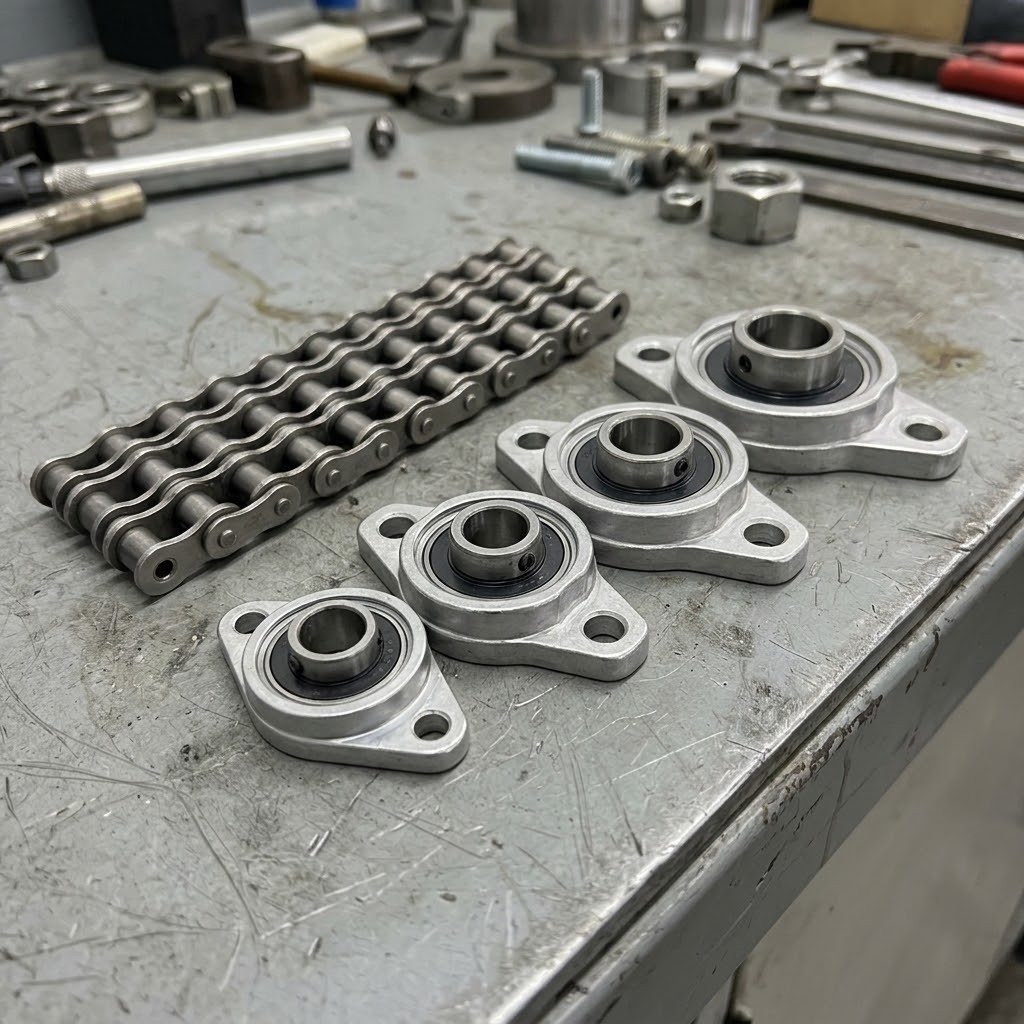
A pillow block bearing (UCP) bolts to a surface parallel to the shaft, while a flange bearing (UCF, UCFL) bolts to a wall or plate perpendicular to it – that is the core difference. The right choice depends on shaft diameter, load direction, mounting surface and operating environment. Pillow block bearings and flange units are both ready-to-mount bearing units: a housing plus an insert bearing with a spherical outer ring. This guide covers the common housing types, how inserts lock to the shaft, housing materials and the main selection criteria, with a comparison table.
What is a pillow block bearing?
A pillow block is a housing with a base and two bolt holes. The base sits parallel to the shaft axis, so the unit is mounted on horizontal surfaces such as conveyor frames, machine beds and structural beams. The bolt holes are usually slotted, which makes it easier to align the shaft during installation.
Pillow blocks perform best when the load acts towards the base. When the load pulls away from the base – trying to lift the housing off its mounting – the permissible housing load drops considerably, so the orientation or housing type should be reconsidered. Variants with tapped holes in the base (e.g. UCPA) are used where the unit has to be bolted from underneath in tight spaces.
What is a flange bearing?
A flange bearing has a housing that mounts on a surface perpendicular to the shaft. When a shaft passes through a machine wall or side plate, the bearing can be bolted straight to that plate, removing the need for a separate bracket and saving space.
- UCF – square flange, 4 bolts: spreads the load over four points for a stiff connection; a common choice for medium and heavy loads.
- UCFL – oval (diamond) flange, 2 bolts: fits narrower mounting areas; used for light to medium loads, especially on slim frames.
- UCFC – round flange with spigot: the spigot locates in a bore in the plate for accurate centring.
Flange housings work best when the load acts in the plane of the flange. Axial loads are limited by the insert bearing, so check the selection if significant thrust is expected.
Take-up units (UCT) and other housing types
A take-up unit (UCT) has a housing that slides in a frame. Turning the adjusting screw moves the bearing to set conveyor belt or chain tension, which is why take-ups are typically found on tail pulleys and on the tensioning side of chain drives. Other options include hanger housings and light pressed-steel housings; pressed-steel units suit light machinery where low load and low cost are the priorities.
Housing types compared
| Housing type | Code | Mounting surface | Bolts | Typical use |
|---|---|---|---|---|
| Pillow block | UCP | Parallel to shaft | 2 | Conveyor frames, general machine shafts |
| Square flange | UCF | Wall/plate perpendicular to shaft | 4 | Medium to heavy loads, rigid fixing |
| Oval flange | UCFL | Wall/plate perpendicular to shaft | 2 | Tight spaces, light to medium loads |
| Round flange | UCFC | Perpendicular plate, piloted | 4 | Applications needing accurate centring |
| Take-up | UCT | Take-up frame | Depends on frame | Belt and chain tensioning |
Insert bearings: how they lock to the shaft
How the insert is fixed to the shaft matters as much as the housing. The spherical outer ring lets the insert self-align within the housing, compensating for small misalignment at installation; it is not intended to absorb continuous shaft deflection in service.
- Set screw (UC series): two grub screws in the extended inner ring clamp onto the shaft. The simplest and most common option, suitable for both directions of rotation. The screw tips can mark the shaft, so check them periodically under heavy vibration.
- Eccentric locking collar: the collar is turned in the direction of rotation and secured with a grub screw. Low risk of shaft damage; best for applications that rotate mainly in one direction.
- Adapter sleeve (UK series + H sleeve): a tapered-bore insert is clamped to the shaft by a tapered adapter sleeve. Concentric clamping makes it a good fit for higher speeds and vibration.
In the UC series the bore is easy to read from the number: for codes 04 and above, multiply the last two digits by 5. A UC205 insert fits a 25 mm shaft, a UC208 a 40 mm shaft. Housing and insert codes combine into the unit name, so UCP205 is a pillow block for a 25 mm shaft.
Housing materials
- Cast iron: the industrial standard, offering good rigidity and vibration damping for dry and general environments.
- Stainless steel: chosen for corrosion resistance in food, beverage and wash-down areas.
- Thermoplastic: light and corrosion resistant, usually paired with a stainless insert on hygienic lines that are cleaned often. Load capacity is lower than cast iron.
- Pressed steel: for light loads and economical designs.
Choosing by shaft size, load and space
Always start with the shaft diameter, because it determines the insert series and size. Then work through these questions:
- Is the mounting surface parallel or perpendicular to the shaft? Parallel means pillow block, perpendicular means flange.
- Which way does the load act? On a pillow block, load towards the base is preferred.
- How much room is there? On narrow frames an oval flange (UCFL) fits more easily.
- Is tension adjustment needed? If so, use a take-up unit (UCT).
- What is the environment? Moisture, wash-down or chemicals call for stainless or thermoplastic housings and suitable seals.
- Are speed and vibration high? Consider an adapter sleeve or eccentric collar insert.
Bearing units usually work alongside sprockets, couplings and pulleys. If you are planning the whole drive line, see our power transmission components for the other parts.
Installation and maintenance
- The shaft must be clean, free of burrs and within the correct tolerance.
- Bolt the housing to a flat, rigid surface and tighten the bolts evenly.
- Align both bearings on the same shaft before tightening the set screws or collar.
- On units with a grease nipple, relubricate with small amounts at regular intervals suited to the duty; too much grease can strain the seals.
- Inspect the unit whenever you notice unusual noise, heat or vibration.
Many bearing units are supplied pre-greased. Dusty, damp or hot conditions shorten relubrication intervals, and in these cases relubricatable units with suitable seals extend service life noticeably.